Published
CA Practice Management
Email vs Client Portal: Which Is Better for CA Firms?
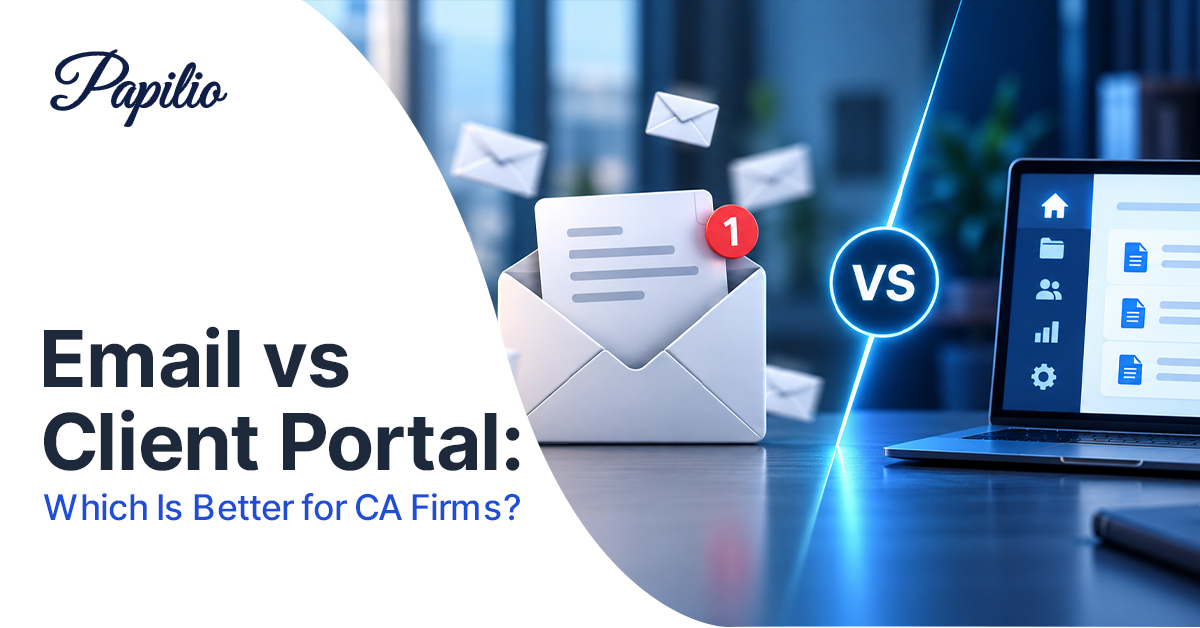
For years, email has been the default way for CA firms to exchange documents, share updates, and follow up with clients. It works, but as the number of clients and documents grows, managing everything through scattered email threads can become difficult. Important files get buried, follow-ups are missed, and finding past communication can be time consuming.
This is where a client platform for CA firms offers a more organized approach. Instead of managing client documents and communication across multiple email threads, firms can bring these interactions into one secure, centralized space with client management software for CA firms.
But does that mean email is no longer useful? Not necessarily. The real question in the email vs client portal debate is which option works better for different aspects of successful client management. Understanding the difference can help CA firms choose a system that improves efficiency without making client communication complicated.
How CA Firms Use Email for Client Communication
Email has long been a familiar tool for CA firms to communicate with clients, share documents, send reminders, and provide updates. For many firms, it remains a convenient option for day-to-day communication, especially when handling individual requests or quick queries.
However, as client interactions increase, managing everything through email can become challenging. Documents may be spread across multiple threads, attachments can be difficult to track, and important follow-ups may get lost among other messages. This is one reason firms are increasingly exploring an accounting client portal as a more organized alternative.
In the email vs client portal comparison, email still works well for simple communication, but a client portal for accountants provides a dedicated space to manage documents, requests, and client interactions in one place.
What Is a Client Portal for CA Firms?
A client portal for CA firms is a secure online platform where firms and clients can manage documents, requests, communication, and important information in one place. Instead of relying on scattered email threads, clients can log in to a dedicated space to upload documents, access files, and respond to requests.
For accounting firms, a client portal creates a more organized way to manage recurring client interactions allowing for seamless tracking of pending documents, share updates, and maintain a clear record of communication.
When comparing email vs client portal, the key difference is organization of information. Email is primarily a communication tool, while a CA firm client portal is designed specifically to streamline ongoing client collaboration and document management.
Email vs Client Portal: Key Differences
The main difference between email vs client portal is how client communication and documents are managed. Email is useful for quick conversations, but information can become scattered across inboxes and multiple threads. A client portal for CA firms brings these interactions into a structured, centralized workspace.
| Factor | Client Portal for CA Firms | |
|---|---|---|
| Document management | Files are shared as email attachments and can get buried in threads. | Documents can be uploaded, accessed, and organized in one dedicated space. |
| Communication | Conversations are spread across individual email threads. | Client requests and communication stay connected to the relevant work. |
| Document tracking | Difficult to know which documents are still pending. | Firms can track submitted and pending documents more systematically. |
| Client access | Clients search through their inbox for old files and messages. | A client portal for accountants gives clients a dedicated place to access information. |
| Organization | Information is distributed across inboxes and attachments. | An accounting client portal keeps client-related information more structured. |
| Scalability | Managing increasing client communication can become time-consuming. | A CA firm client portal can support a more organized workflow as the firm grows. |
This doesn't mean email becomes unnecessary. For quick updates and routine conversations, it remains useful. However, when a firm needs a more structured way to manage documents and ongoing client interactions, a client portal for CA firms can offer a more practical approach.
7 Reasons CA Firms Should Consider a Client Management Portal
A client portal for CA firms provides a centralized way to organize client interactions while reducing the back-and-forth involved in everyday communication.
Here are seven reasons why CA firms should consider adopting one:
1. Keep Client Documents in One Place
With email, important files can be spread across different conversations and attachments. A client portal for accountants gives firms and clients a dedicated space to upload, access, and manage documents, while document management software helps keep information organized and easier to find when needed.
2. Reduce Repeated Follow-Ups
Chasing clients for missing documents can take up a significant amount of a team's time. An accounting client portal can help firms keep track of document requests and pending submissions, reducing unnecessary email exchanges and follow-ups.
3. Make Client Communication More Organized
The email vs client portal difference becomes particularly clear when communication increases. Instead of managing several email threads for the same client, a CA firm client portal can bring relevant requests, documents, and updates into one organized environment.
4. Give Clients Easy Access to Documents
Clients shouldn't have to search through their inbox every time they need an old document. A client portal for CA firms gives clients a dedicated place to access shared files and information, making the overall experience simpler.
5. Improve Workflow Visibility
When client requests are managed through scattered emails, it can be difficult to know what has been completed and what still needs attention. A client portal for accountants combined with workflow automation software can provide better visibility into pending requests, submissions, and ongoing client tasks.
6. Support Better Data Organization
CA firms handle sensitive financial and business information every day. Moving client-related documents and interactions into a structured accounting client portal can help firms maintain better control over how information is shared and accessed, alongside appropriate security practices.
7. Scale Client Management More Efficiently
As a firm grows, managing every client through individual email conversations can become increasingly difficult. A CA firm client portal provides a more structured system for handling recurring document collection, communication, and client requests, while team collaboration software can help teams coordinate these activities more efficiently.
Is Email Still Useful for CA Firms?
Yes, email still has a place in CA firms. It works well for quick updates, appointment confirmations, general queries, and simple client communication. A client portal for CA firms is not meant to replace email completely, but to reduce the need to manage document-heavy and recurring client interactions through inboxes.
In the email vs client portal comparison, the right choice depends on the task. Email is useful for quick communication, while a client portal for accountants or accounting client portal provides a more organized space for documents, requests, and ongoing workflows. A CA firm client portal can therefore complement email rather than replace it.
When Should a CA Firm Use a Client Management Portal?
A CA firm should consider a client portal for CA firms when client communication involves frequent document collection, repeated follow-ups, approvals, or multiple ongoing requests. If teams are spending too much time searching through email threads or tracking which clients have submitted documents, a portal can bring these tasks into one organized system.
An accounting client portal is particularly useful for firms managing a growing client base, recurring compliance work, or large volumes of financial documents. A client portal for accountants can make it easier to manage client requests, while a CA firm client portal gives clients a dedicated space to upload and access documents. In the email vs client portal comparison, this makes a portal the more practical option when organisation and workflow visibility become priorities.
How Papilio Helps CA Firms Move Beyond Email
Papilio helps CA firms move beyond scattered email threads by bringing client communication, document sharing, and workflow management into one organised platform. With a client portal for CA firms, firms can create a smoother way for clients to submit documents, access information, and stay updated without relying on long email chains.
For firms comparing email vs client portal, Papilio provides a more structured approach to everyday client management. Its client portal for accountants helps centralise client interactions, while an accounting client portal can make document collection and follow-ups easier to manage. For growing firms, a CA firm client portal can help create a more consistent and organised client experience while reducing unnecessary back-and-forth.
Email or Client Portal: Which Should Your CA Firm Choose?
The choice between email vs client portal depends on how your CA firm manages client communication and documents. Email is still effective for quick updates, simple queries, and routine communication. However, if your firm regularly handles document collection, client requests, approvals, and follow-ups, a client portal for CA firms can provide a more organised way to manage these processes.
For growing firms, a client portal for accountants or accounting client portal can reduce scattered communication and make client information easier to manage. A CA firm client portal doesn't have to replace email entirely, it can work alongside it, allowing firms to use email where it makes sense while moving document-heavy and recurring workflows into a dedicated platform like Papilio.
Conclusion
For CA firms, email remains useful for quick communication, but it can become difficult to manage when client documents, requests, and follow-ups start piling up. A client portal for CA firms provides a more organised way to handle these recurring interactions while keeping client information easier to access and manage.
The email vs client portal debate is not necessarily about choosing one over the other. With an accounting client portal or client portal for accountants, firms can use the right tool for the right task. For growing firms, a CA firm client portal can help simplify workflows, reduce unnecessary back-and-forth, and create a more seamless client experience.
Frequently asked questions
Common questions about email vs client portals for CA firms, including features, security, document management, and choosing the right approach for client communication.
What is a client portal for CA firms?
A client portal for CA practice is a secure, centralised platform where firms and clients can share documents, manage requests, track communication, and access important information without relying entirely on email.
Is a client portal more secure than email?
A client portal for accountants can provide better control over client information through features such as access permissions, secure document sharing, and centralised storage, reducing reliance on unsecured email attachments.
How does a client portal help accounting firms manage documents?
An accounting client portal helps accountants organise client documents in one place, making it easier to collect files, track submissions, access previous records, and reduce time spent searching through email attachments.
Can CA firms completely replace email with a client portal?
A CA firm client portal does not necessarily need to replace email. Firms can use portals for documents and recurring workflows while continuing to use email for quick updates, queries, and general communication.
What features should an accounting client portal have?
A client portal for CA firms should include secure document sharing, client access controls, file organisation, notifications, request tracking, communication tools, and an intuitive interface that makes collaboration easier for both firms and clients.
How does a client portal improve client experience?
A client portal for accountants gives clients one convenient place to upload documents, access files, respond to requests, and stay informed, creating a smoother experience with fewer repetitive emails and follow-ups.